01Proposed start
10 MWp
Project Zero
Proposed 10 MWp solar PV reference project. A storage option will be assessed within feasibility; no storage capacity or budget has been adopted.

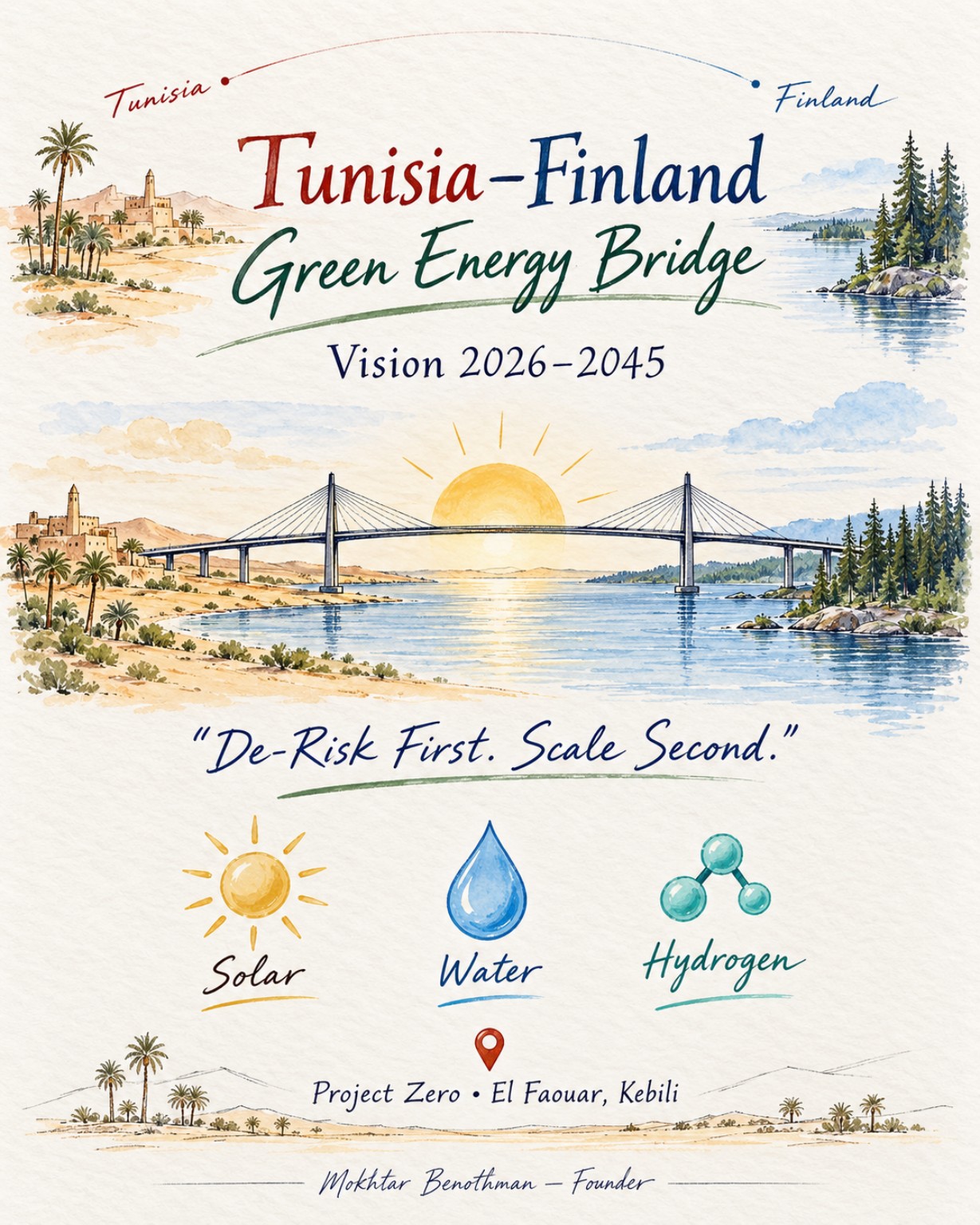
Tunisia–Finland Vision 2026–2045
Project Zero is the proposed starting project, not the full platform ambition. Its purpose is to validate a development model capable of supporting larger stages. Progression occurs only where land, grid, authorisations, commercial structure and financing are confirmed.
Proposed 10 MWp solar PV reference project. A storage option will be assessed within feasibility; no storage capacity or budget has been adopted.
A larger development stage after the model and delivery structure are validated.
Multiple opportunities advanced under separate site, grid, regulatory and investment decisions.
Long-term ambition: solar, storage, renewable-powered water, green hydrogen and knowledge transfer. Each opportunity requires separate feasibility and financing.
Growth beyond Project Zero will follow the legal pathway and proven feasibility of each project: the authorization regime, self-generation for eligible consumers, partnership in public concession tenders, or joining existing projects. Each step is decided by the competent bodies of each project company, in line with Tunisian law and the contractual rights of all parties.
All post-Project Zero capacity figures shown above are strategic ambitions, not an owned, permitted, contracted or financed pipeline. Each stage is conditional and may comprise one or more projects.
Seeking technology and investment partners · Proposed Centre of Excellence, Kébili
Project Zero · Proposed 10 MWp solar PV
Land rights, grid connection, authorisation, PPA and financing secured?
Pause, reassess or redesign
Reassess the conditions before proceedingConstruction and operation · Electricity sales to STEG
Reference project: 10 MWp solar PV. A storage option will be assessed within the feasibility study; no storage capacity or budget has been adopted.
Storage assessment must identify the economic or contractual benefit that justifies its cost. If no sufficient benefit is demonstrated, storage will be excluded from the project scope.
Land-control instrument and STEG connection assessment for Project Zero. Confirmed regulatory pathway, independent yield and environmental studies, viable financial model.
Assess services, operating needs, losses and total storage cost. An evidenced revenue or contractual benefit that supports the investment; integration or separate SPV as appropriate.
Collect reliable production, weather, dust and maintenance data. Demonstrated improvement against a baseline; usable data and sustainable service economics.
Define an emissions baseline and measurement method. Independent verification where required; no carbon-credit income assumed before eligibility is established.
Assess demand, water source, energy needs and brine management. Resource rights, permits, environmental acceptability, customer and viable water-service economics.
Assess coastal locations, renewable electricity, sustainable water, buyers and logistics. Separate water budgets must protect household and oasis needs. Progress requires credible offtake, safety, certification, permits and competitive economics.
Each stage of the vision would be developed as a separate project, under the authorization regime or a concession procedure depending on its individual capacity and the applicable framework. Portfolio size does not determine the procedure; each project is assessed on its own.
Our ambition is to help advance Tunisia’s energy sector and build a hub for knowledge exchange across Africa, the Arab world, the Mediterranean and Europe.
The proposed centre begins as an open framework for applied research, training and knowledge transfer. Its first proposed pilot measures dust, panel cleaning and water use for Project Zero, comparing practical cleaning methods before adopting AI. Local measurements will test the potential benefit; no savings are guaranteed.
The Centre of Excellence would seek cooperation with universities and research centres in Tunisia and Finland. No cooperation agreement exists at this stage.
Universities, research centres, companies and public institutions from all regions are welcome to propose or lead a study, a pilot or a training programme with BGEB. We welcome initiatives that demonstrate practical value for Tunisia and potential exchange across Africa, the Arab world, the Mediterranean and Europe.
Each collaboration will define its scope, funding, responsibilities, data access, intellectual property and publication rights in writing.
Propose a research or training initiativeKébili: groundwater protection, efficient oasis water use, reuse and suitable brackish-water treatment. Gabès and Médenine: coastal desalination and industrial water options. Each opportunity requires a permitted source, specified water quality, a paying customer, delivered-water economics and an acceptable brine solution. Desalination does not itself resolve groundwater depletion.